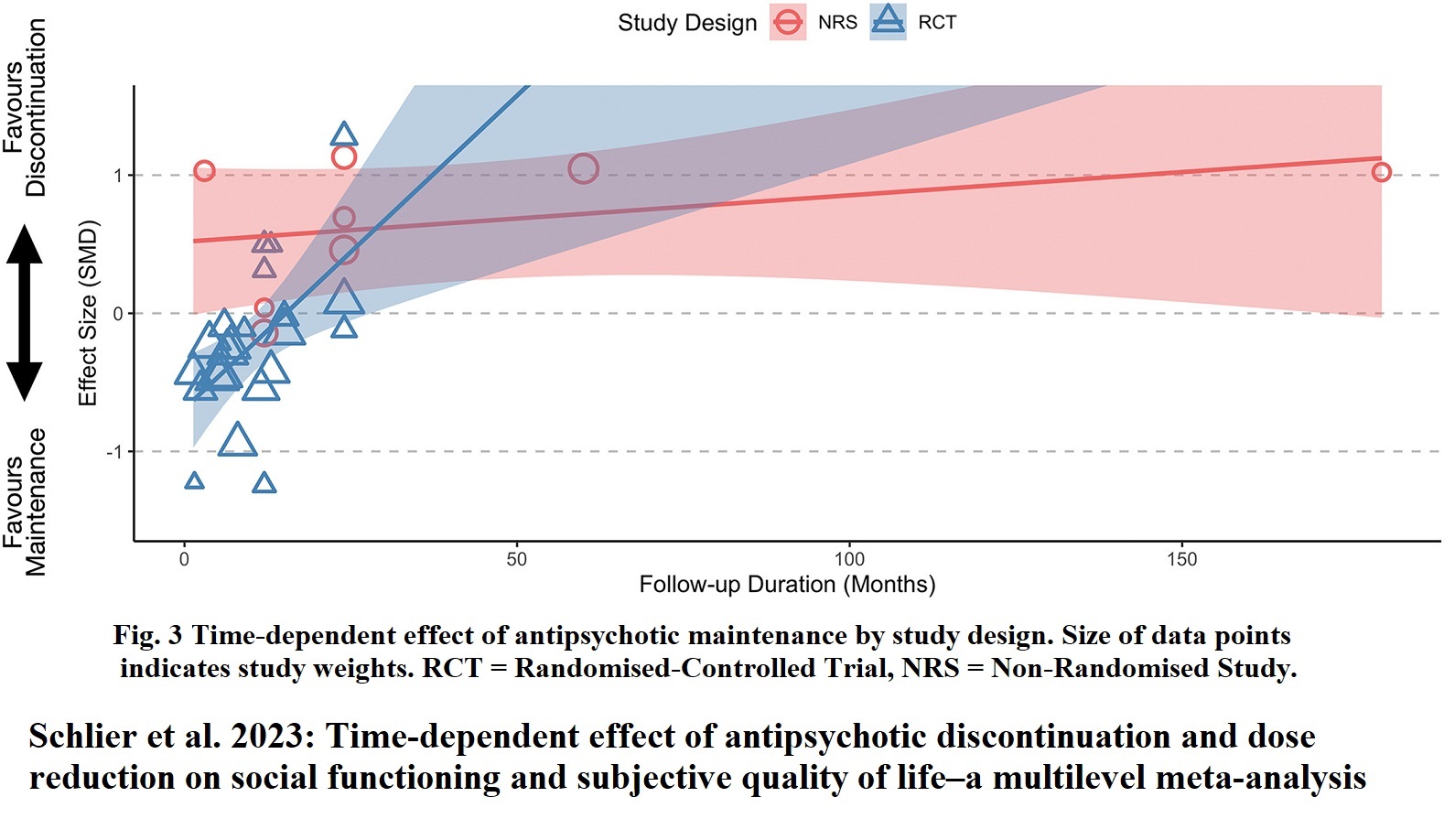
Figure 1: Time-dependent effect of antipsychotic discontinuation
Cognitive Behavioral Therapy (CBT) was significantly superior to treatment as usual (TAU) for the outcome “overall symptoms”, “quality of life” and “functioning” WHO 2023 (mhGAP) guideline
Walter Keim
Støleveien 180
N-4887 Grimstad, 5. September 2026
Norway
Correspondence:
Walter Keim Email: walter.keim@gmail.com DOI: 10.13140/RG.2.2.10902.31046
Published in Mad in America 11. September 2026.
A Call for a Paradigm Shift in Schizophrenia Treatment: Reassessing Long Term Antipsychotic Use and the Evidence for Psychosocial Interventions
Long term antipsychotic treatment shows diminishing benefits, weak evidence for first episode psychosis, and substantial confounding from withdrawal effects. Psychosocial interventions—particularly Cognitive Behavioral Therapy and Open Dialogue—demonstrate superior functional and recovery outcomes. Current evidence supports shifting from lifelong antipsychotic maintenance toward recovery oriented, medication free or reduced medication approaches. Calling all medication-free treatment ideological is not supported by current evidence.
As a graduate in physical
engineering, my entire professional life has been anchored in data,
systemic analysis, and the rigorous verification of evidence. In
engineering, when a system consistently fails or produces severe,
unintended side effects, we do not simply double down on the faulty
mechanism. We analyze the root cause, re-examine the foundational
assumptions, and pivot toward solutions that are empirically proven
to work. Unfortunately, when I turned my analytical lens toward
modern psychiatry—specifically the treatment of schizophrenia and
the widespread reliance on long-term antipsychotic maintenance—I
discovered a profound disconnect between clinical dogma and
empirical reality.
My journey into this field was not
born out of abstract academic curiosity. It was forged through
extensive personal exposure to the mental health system in Norway,
where I documented severe, systematic violations of patient autonomy
and a pervasive reliance on forced medication. These experiences
forced me to confront a troubling truth: the very institutions
tasked with healing individuals are frequently causing profound,
long-lasting harm under the guise of medical necessity. This
realization led me to thoroughly investigate the scientific
literature, legal frameworks, and international human rights
standards surrounding psychiatric care.
International concern is growing regarding the dominance of the biomedical model in mental health care. The United Nations Special Rapporteur on the right to health has argued that global mental health systems rely excessively on psychotropic medication and insufficiently on psychosocial interventions¹. This critique aligns with emerging evidence questioning the long term effectiveness of antipsychotics and highlighting the benefits of psychosocial approaches²,³.
Figure 1: Time-dependent effect of antipsychotic discontinuation
Antipsychotics reduce relapse rates from 65% to 27% within one year⁴. However, this benefit is strongly time dependent, with meta analytic evidence showing substantial decline after two years⁵,⁶. Long term functional outcomes may even favor discontinuation: a four year randomized controlled trial reported better functioning three years after discontinuation compared to maintenance therapy⁷.
No placebo controlled trials include antipsychotic naïve participants, limiting the validity of conclusions about efficacy in first episode psychosis. The Norwegian Institute of Public Health concuded: "It is uncertain if antipsychotics compared to placebo affects symptoms in persons with early psychosis"⁹. Systematic reviews highlight that withdrawal effects in placebo groups compromise the interpretability of existing trials¹⁰. Despite this, antipsychotic prescribing remains nearly universal in some countries, with rates exceeding 97% in first episode psychosis¹¹,¹⁶.
Across sixty years of placebo controlled trials, only 9% of patients achieve a “good response” attributable to antipsychotics¹². The majority do not experience clinically meaningful improvement, raising questions about the centrality of antipsychotics in acute care.
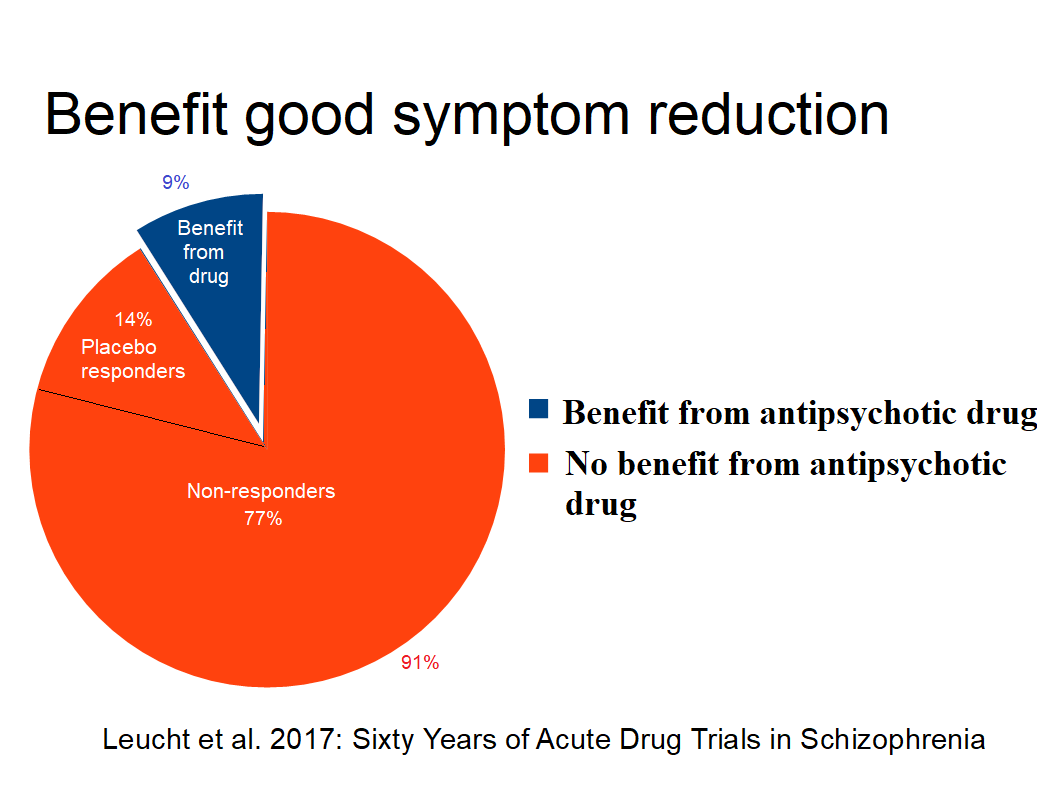
Figure 2: Good acute symptom reduction
Systematic reviews find no robust evidence supporting long term antipsychotic therapy¹³. The CATIE trial, involving 1,124 participants, reported a 72% discontinuation rate, underscoring tolerability and effectiveness challenges²¹. These findings suggest that long term pharmacotherapy may not align with patient experience or long term recovery trajectories. The studies of Harrow and Wunderink support this argument.
Psychosocial interventions—including Cognitive Behavioral Therapy, supportive psychotherapy, and Open Dialogue—demonstrate superior outcomes in symptoms, functioning, and quality of life²,see WHO 2023 (mhGAP) guideline3, and Ranjan, R. et al. 2025¹⁵. Long term observational data from Open Dialogue show substantially lower medication use, reduced disability, and fewer readmissions¹⁶. Despite strong evidence, these interventions remain underutilized due to systemic and cultural barriers¹⁷,¹⁸.

Figure 3: Open dialogue results after 19 years¹⁶
Open Dialogue versus treatment as usual (TAU) for adults presenting in crisis to mental health services in England (the ODDESSI Trial) is a multisite cluster-randomised 2 years trial. Although Open dialogue uses less medication the time to first relapse was not inferior compared to TAU. Open Dialogue reduced acute inpatient bed use, improved service user reported outcomes and experience, and there were no significant safety concerns¹².
Some authors describe medication free approaches as ideological²². However, this framing assumes that antipsychotics are both effective and tolerable long term—conditions not supported by current evidence. A rational, evidence based approach requires reconsidering the default of lifelong medication and expanding access to psychosocial interventions.
The cumulative evidence challenges the assumption that lifelong antipsychotic treatment is necessary or beneficial for most individuals with schizophrenia. Psychosocial interventions demonstrate superior long term outcomes and align with patient preferences¹⁹,²⁰.
A recovery oriented paradigm emphasizing medication free or reduced medication approaches is warranted and consistent with international calls for reform¹. A shift of paradigm may promote recovery²³.
Pūras, D. Report of the Special Rapporteur on the right of everyone to the enjoyment of the highest attainable standard of physical and mental health. United Nations Human Rights Council (2017).
Bighelli, I. et al. Cognitive behavioural therapy for schizophrenia: A systematic review and meta-analysis. Psychol. Med. 48, 1–12 (2018).
World Health Organization. mhGAP Intervention Guide, Version 3.0. WHO (2023).
Leucht, S. et al. Antipsychotic drugs versus placebo for relapse prevention in schizophrenia: A systematic review and meta-analysis. Lancet 385, 1376–1384 (2015).
Ceraso, A. et al. Maintenance treatment with antipsychotic drugs for schizophrenia. Cochrane Database Syst. Rev. 3, CD008016 (2020).
Leucht, S. et al. Relapse prevention in schizophrenia with new-generation antipsychotics: A systematic review and exploratory meta-analysis. Am. J. Psychiatry 169, 120–129 (2012).
Schlier, B. et al. Long-term outcomes after antipsychotic discontinuation: A meta-analytic extrapolation. Schizophr. Bull. 49, 1–10 (2023).
Sommer, I. E. et al. Long-term outcomes after guided antipsychotic discontinuation: A 4-year randomized controlled trial. Psychol. Med. (2025).
Dalsbø, T. K. et al. Antipsychotics for early psychosis: A systematic review. Norwegian Institute of Public Health (2019) https://www.fhi.no/en/publ/2019/Effectiveness-of-treatment-for-psychosis/.
Danborg, P. B., Simonsen, S. & Gøtzsche, P. C. Long-term antipsychotic use: A critical review of placebo-controlled trials. Psychother. Psychosom. 88, 1–10 (2019) .
Bergström, T. et al. The 10-year treatment outcome of open dialogue-based psychiatric services for adolescents: A nationwide longitudinal register-based study. Early Interv. Psychiatry Volume16, Issue12 December 2022 Pages 1368-1375 25 March 2022 https://doi.org/10.1111/eip.13286.
Pilling S, Craig T, Clarke K et al. Open Dialogue versus treatment as usual for adults presenting in crisis to mental health services in England (the ODDESSI Trial): a multisite cluster-randomised trial The Lancet Psychiatry, 2026; 0
Leucht, S. et al. Sixty years of placebo-controlled antipsychotic drug trials in acute schizophrenia: Systematic review and meta-analysis. Mol. Psychiatry 22, 1–9 (2017).
Sohler, N. et al. Weighing the evidence for harm from long-term treatment with antipsychotic medications: A systematic review. Am. J. Orthopsychiatry 85, 1–13 (2015).
Ranjan, R. et al. Effectiveness of psychological interventions for positive and negative symptoms in schizophrenia: A systematic review and network meta-analysis. Schizophr. Res. (2025).
Bergström, T., Seikkula, J. et al. The family-oriented open dialogue approach in the treatment of first-episode psychosis: Nineteen-year outcomes. Psychiatry Res. 2018 Dec;270:168-175. doi: 10.1016/j.psychres.2018.09.039. Epub 2018 Sep 18. PMID: 30253321.
Polese, D. et al. Psychotherapy in treatment-resistant schizophrenia: A 25-year systematic review and exploratory meta-analysis. Schizophr. Res. 210, 1–9 (2019).
Tandon, R. et al. Psychosocial interventions and functional recovery in schizophrenia—Realizing opportunities today. npj Schizophr. 11, 1–8 (2025).
McHugh, R. K. et al. Patient preferences for psychological vs. pharmacological treatments. J. Clin. Psychiatry 74, 595–602 (2013).
Angermeyer, M. C. et al. Public attitudes toward medication-free treatment in psychosis. Soc. Psychiatry Psychiatr. Epidemiol. 52, 1–9 (2017).
Levine, S. Z. et al. Dropout patterns in the CATIE trial: Implications for long-term antipsychotic treatment. Schizophr. Res. 136, 1–7 (2012).
Leucht, S., Rodolico, A. Empowering clinicians and patients in antipsychotic dose reduction for schizophrenia: the role of online tools. Schizophr 11, 153 (2025). https://doi.org/10.1038/s41537-025-00699-7
Keim, Walter. Paradigm Shift to Promote a Revolution of Treatment of Schizophrenia to Achieve Recovery. Medical Research Archives, [S.l.], v. 11, n. 12, dec. 2023. ISSN 2375-1924. Available at: https://esmed.org/MRA/mra/article/view/4866. https://doi.org/10.18103/mra.v11i12.4866
No new data were generated for this manuscript.
The author declares no competing interests.
None.
