A Call for a Paradigm Shift in Schizophrenia Treatment
By Walter Keim
Long term antipsychotic treatment shows diminishing benefits, weak evidence for first episode psychosis, and substantial confounding from withdrawal effects. Psychosocial interventions—particularly Cognitive Behavioral Therapy and Open Dialogue—demonstrate superior functional and recovery outcomes. Current evidence supports shifting from lifelong antipsychotic maintenance toward recovery oriented, medication free or reduced medication approaches. Calling all medication-free treatment ideological is not supported by current evidence
Contence
Introduction: An Engineer's Perspective on Psychiatry 1
The Reality of the Norwegian System: Policy vs. Practice 5
The Legal Turning Point: Landmark Rulings on Human Rights 6
Deconstructing the Paternalistic Dogma: A Response to Stefan Leucht 6
The Scientific Contradiction: Leucht's Own Data vs. His Rhetoric 7
As a
graduate in physical engineering, my entire professional life has
been anchored in data, systemic analysis, and the rigorous
verification of evidence. In engineering, when a system consistently
fails or produces severe, unintended side effects, we do not simply
double down on the faulty mechanism. We analyze the root cause,
re-examine the foundational assumptions, and pivot toward solutions
that are empirically proven to work. Unfortunately, when I turned my
analytical lens toward modern psychiatry—specifically the treatment
of schizophrenia and the widespread reliance on long-term
antipsychotic maintenance—I discovered a profound disconnect
between clinical dogma and empirical reality.
My journey
into this field was not born out of abstract academic curiosity. It
was forged through extensive personal exposure to the mental health
system in Norway, where I documented severe, systematic violations of
patient autonomy and a pervasive reliance on forced medication. These
experiences forced me to confront a troubling truth: the very
institutions tasked with healing individuals are frequently causing
profound, long-lasting harm under the guise of medical necessity.
This realization led me to thoroughly investigate the scientific
literature, legal frameworks, and international human rights
standards surrounding psychiatric care.
International concern is growing regarding the dominance of the biomedical model in mental health care. The United Nations Special Rapporteur on the right to health has argued that global mental health systems rely excessively on psychotropic medication and insufficiently on psychosocial interventions¹. This critique aligns with emerging evidence questioning the long term effectiveness of antipsychotics and highlighting the benefits of psychosocial approaches²,³.
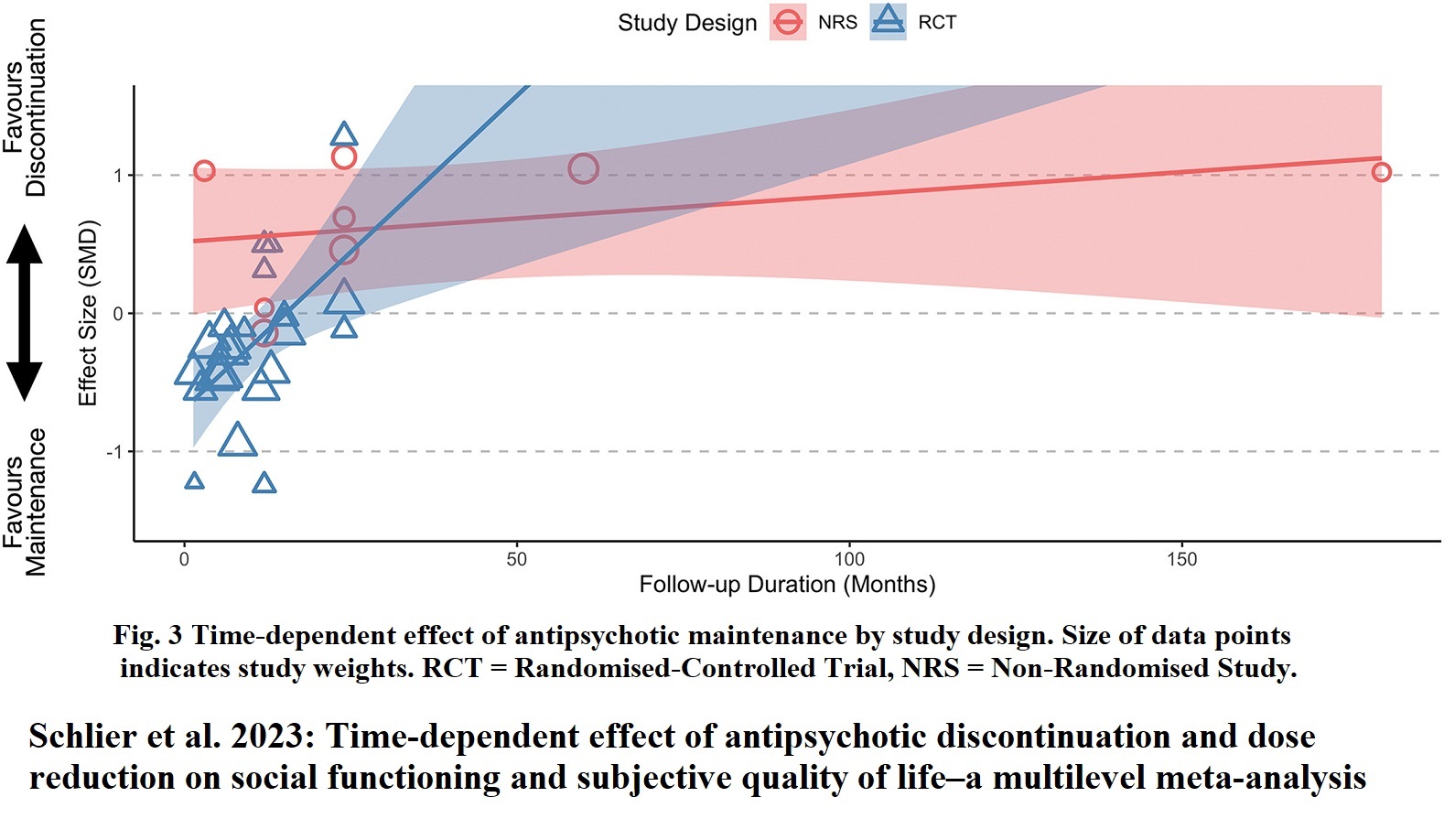
Figure 1: Time-dependent effect of antipsychotic discontinuation
Antipsychotics reduce relapse rates from 65% to 27% within one year⁴. However, this benefit is strongly time dependent, with meta analytic evidence showing substantial decline after two years⁵,⁶. Long term functional outcomes may even favor discontinuation: a four year randomized controlled trial reported better functioning three years after discontinuation compared to maintenance therapy⁷.
No placebo controlled trials include antipsychotic naïve participants, limiting the validity of conclusions about efficacy in first episode psychosis. The Norwegian Institute of Public Health concuded: "It is uncertain if antipsychotics compared to placebo affects symptoms in persons with early psychosis"⁹. Systematic reviews highlight that withdrawal effects in placebo groups compromise the interpretability of existing trials¹⁰. Despite this, antipsychotic prescribing remains nearly universal in some countries, with rates exceeding 97% in first episode psychosis¹⁵.
Across sixty years of placebo controlled trials, only 9% of patients achieve a “good response” attributable to antipsychotics¹². The majority do not experience clinically meaningful improvement, raising questions about the centrality of antipsychotics in acute care.
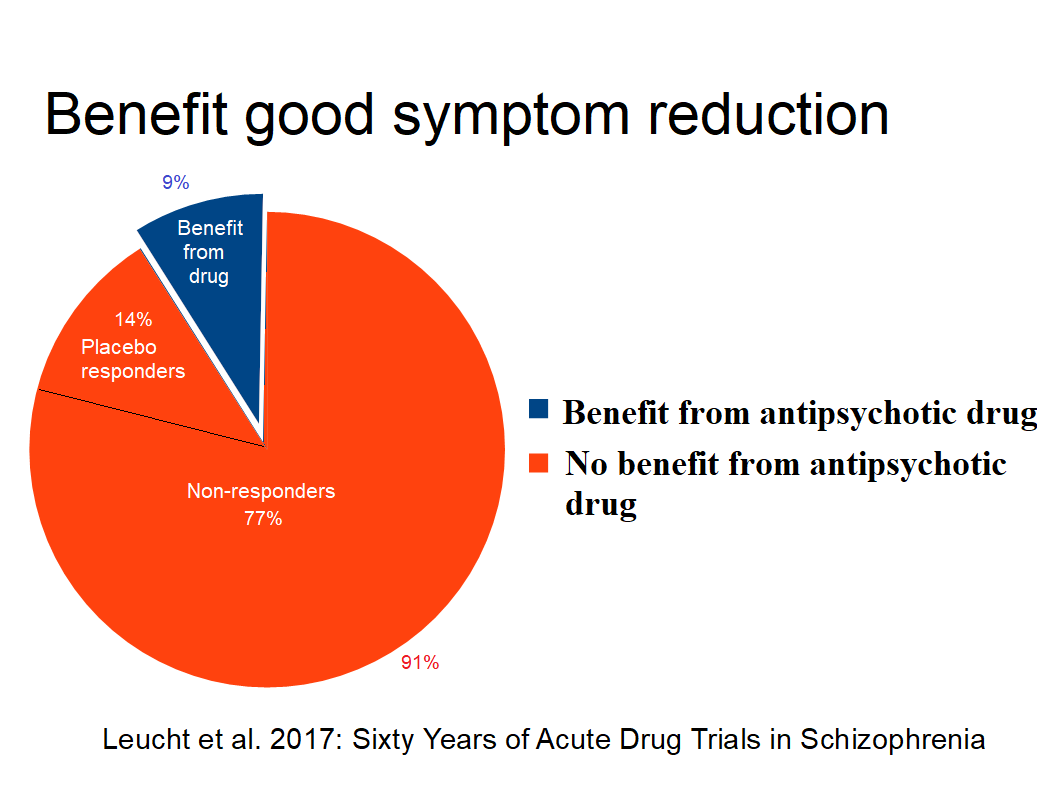
Figure 2: Good acute symptom reduction
Systematic reviews find no robust evidence supporting long term antipsychotic therapy¹³. The CATIE trial, involving 1,124 participants, reported a 72% discontinuation rate, underscoring tolerability and effectiveness challenges²⁰. These findings suggest that long term pharmacotherapy may not align with patient experience or long term recovery trajectories. The studies of Harrow and Wunderink support tis argument.
Psychosocial interventions—including Cognitive Behavioral Therapy, supportive psychotherapy, and Open Dialogue—demonstrate superior outcomes in symptoms, functioning, and quality of life²,see WHO 2023 (mhGAP) guideline3, and Ranjan, R. et al. 2025¹⁴. Long term observational data from Open Dialogue show substantially lower medication use, reduced disability, and fewer readmissions¹¹,¹⁵. Despite strong evidence, these interventions remain underutilized due to systemic and cultural barriers¹⁶,¹⁷.

Figure 3: Open dialogue results after 19 years¹⁵
Open Dialogue versus treatment as usual (TAU) for adults presenting in crisis to mental health services in England (the ODDESSI Trial) is a multisite cluster-randomised 2 years trial. Although Open dialogue uses less medication the time to first relapse was not inferior compared to TAU. Open Dialogue reduced acute inpatient bed use, improved service user reported outcomes and experience, and there were no significant safety concerns.
Some authors describe medication free approaches as ideological²¹. However, this framing assumes that antipsychotics are both effective and tolerable long term—conditions not supported by current evidence. A rational, evidence based approach requires reconsidering the default of lifelong medication and expanding access to psychosocial interventions.
The cumulative evidence challenges the assumption that lifelong antipsychotic treatment is necessary or beneficial for most individuals with schizophrenia. Psychosocial interventions demonstrate superior long term outcomes and align with patient preferences¹⁸,¹⁹. A recovery oriented paradigm emphasizing medication free or reduced medication approaches is warranted and consistent with international calls for reform¹. A shift of paradigm may promote recovery²².
Norway
is often lauded internationally for its progressive mental health
policies. In 2016, the Norwegian Ministry of Health issued a historic
directive mandating that all regional health authorities establish
medication-free treatment units. This was a monumental victory for
patient organizations who had campaigned for decades for the right to
choose treatment paths that do not involve heavy neuroleptics. The
policy was designed to give patients a voice, offering structured
psychosocial support, physical exercise, and tailored therapies
instead of immediate, forced chemical intervention.
However,
there is a vast and devastating chasm between official policy and
ground-level practice. In reality, the implementation of
medication-free options has been fiercely resisted by the psychiatric
establishment, and the actual availability of these beds remains
microscopic. More alarmingly, the practice of forced drugging remains
exceptionally high in Norway compared to other European nations. My
own extensive documentation of these practices—shared publicly to
expose these failures—reveals that the supervisory authorities,
specifically the State Governor (Statsforvalteren) and the
Directorate of Health (Helsedirektoratet), routinely rubber-stamp
decisions for forced medication.
When patients appeal
against forced treatment, their complaints are almost systematically
dismissed. The legal protections intended to safeguard vulnerable
citizens have mutated into bureaucratic exercises that shield the
psychiatric system from accountability. This lack of reall-world
self-determination is not just a clinical failure; it is a profound
failure of governance and human rights oversight.
For
years, activists and affected individuals argued that these practices
violated fundamental human rights, only to be met with institutional
denial. However, the legal landscape in Norway has recently undergone
a seismic shift. Landmark judicial decisions have shattered the
illusion of legal compliance within the psychiatric sector, providing
irrefutable proof of systemic human rights violations.
The
first major breakthrough was the Eidsvik case (Borgarting Court of
Appeal, January 2026). Inger-Mari Eidsvik, supported by the pro bono
group of ICJ-Norway, successfully sued the state. The court ruled
that the state had violated the European Convention on Human Rights
(ECHR), specifically Article 3 (prohibition of inhuman or degrading
treatment) and Article 8 (right to respect for private and family
life). The court made it clear that informal procedures, lack of
proper documentation, and arbitrary forced medication constitute a
direct assault on a person's physical and psychological integrity.
Crucially, the judgment established that the state cannot escape its
human rights obligations by delegating authority to local health
trusts.
Shortly thereafter, another harrowing case came to
light: the Helen Wesnes case (Romerike and Glåmdal District Court,
June 2026). Helen Wesnes was subjected to a staggering 15 years of
erroneous psychiatric treatment, during which she was forcibly
medicated, locked in isolation, and placed in mechanical restraints a
shocking 78 times. It was later revealed that her initial diagnosis
of schizophrenia was entirely incorrect. The district court delivered
a scathing judgment against the state, awarding Wesnes 4.5 million
NOK in damages for gross violations of ECHR Articles 3, 5 (right to
liberty and security), and 8. These cases are not isolated incidents;
they are symptomatic of an unaccountable system that routinely
overrides human rights in the name of paternalistic medicine.
Despite
these damning legal defeats and a growing global consensus demanding
reform, prominent figures within the psychiatric establishment
continue to defend the status quo with aggressive rhetoric. A prime
example of this defensive posture can be found in a recent article
published in Nature (2025) by Dr. Stefan Leucht, a highly influential
psychiatrist known for his extensive work on antipsychotic trials. In
his advice to clinicians, Dr. Leucht writes:
'There is a
"medication-free life" ideology that extends beyond
psychiatry. It is an ideology because, if medication helps a patient
remain well and is tolerable, it is irrational to stop it. We need to
empower both clinicians and patients to make rational decisions.'
As
an engineer trained to evaluate hypotheses based strictly on
objective data, I find Dr. Leucht’s assertion deeply troubling,
scientifically flawed, and actively misleading. To label the desire
for a medication-free life as an 'ideology' or to dismiss the
discontinuation of neuroleptics as 'irrational' is a form of
gaslighting that ignores both patient preference and massive bodies
of empirical data. Ironically, Dr. Leucht’s own collaborative
research directly contradicts the very paternalistic message he is
now promoting.
Let us
examine the actual scientific evidence. Dr. Leucht was a co-author of
the World Health Organization’s (WHO) 2023 mhGAP guidelines. The
conclusions were explicit and unambiguous: Cognitive Behavioral
Therapy (CBT) was significantly superior to treatment as usual (TAU)
across multiple critical outcomes, including 'overall symptoms',
'quality of life', and 'functioning'.
The WHO 2023
guidelines themselves heavily emphasize the utilization of
psychosocial interventions, including CBT and family therapies, as
essential components of recovery. If the highest level of psychiatric
evidence demonstrates that non-pharmacological, psychosocial
interventions result in superior long-term functioning and quality of
life, how can seeking a life free from heavy chemical dependency be
branded as an 'irrational ideology'?
Furthermore, the
assumption that long-term antipsychotic maintenance is universally
beneficial is built on remarkably weak foundations. A critical
analysis of first-episode psychosis literature reveals a shocking
lack of long-term, placebo-controlled trials involving
antipsychotic-naïve participants. Most maintenance studies suffer
from a severe confounding variable: drug withdrawal effects. When a
patient abruptly stops a powerful neuroleptic, the brain—which has
adapted to severe dopamine blockade—experiences a state of
dopaminergic supersensitivity. This frequently triggers a severe
relapse. Culturally, psychiatry interprets this relapse as proof of
the underlying illness, whereas an objective system analysis reveals
it is often an artifact of drug withdrawal. Long-term outcome
studies, such as the landmark longitudinal research by Martin Harrow
and colleagues, have repeatedly shown that individuals with
schizophrenia who discontinue antipsychotics exhibit significantly
higher recovery rates and better global functioning over a 20-year
period compared to those who remain continuously medicated. Lex
Wunderins well-known study confirms this in a 7-year study.
Dr.
Leucht’s argument hinges entirely on the phrase 'if medication
helps a patient remain well and is tolerable.' This completely
minimizes the profound, documented toxicities of long-term
neuroleptic use. Antipsychotic medications are associated with
structural brain changes, severe metabolic syndrome, cardiovascular
disease, tardive dyskinesia, and a dramatically shortened life
expectancy—often reduced by 15 to 20 years. For a patient to decide
that these physical risks outweigh the marginal, short-term benefits
of symptom suppression is not 'irrational.' It is a highly rational,
calculated decision about their own bodily integrity and long-term
survival.
When we look at alternative care paradigms like
the Open Dialogue approach developed in Western Lapland, Finland, we
see the practical proof of a reduced-medication framework. Open
Dialogue prioritizes immediate psychosocial and network-based
intervention, utilizing antipsychotic medications conservatively and
only if absolutely necessary. The long-term results are astonishing:
approximately 80% of patients return to full-time employment or
study, and the vast majority remain completely free of antipsychotic
medications at long-term follow-up. This is not an 'ideology'; it is
an empirically verified, highly successful clinical reality.
The
evidence is clear, whether it comes from the World Health
Organization’s (WHO) 2023 mhGAP guidelines, the harrowing legal
judgments of the Norwegian courts, or the lived experiences of
thousands of individuals who have suffered under forced treatment.
The current psychiatric paradigm, which prioritizes lifelong chemical
maintenance and treats patient resistance as irrational, is
unsustainable and harmful.
We must align clinical practice
with contemporary evidence and human rights standards, as demanded by
the United Nations Special Rapporteur on the right to health. This
means dismantling the bureaucratic structures—such as those
overseen by the Norwegian Helsedirektoratet—that permit rampant,
unconstitutional forced drugging. It means investing heavily in
genuine medication-free alternatives, CBT, and systemic approaches
like Open Dialogue.
True empowerment does not mean
convincing a patient to 'rationally' accept lifelong chemical
restraint. True empowerment means respecting their autonomy,
defending their legal rights, and providing them with the
psychosocial tools necessary to achieve a self-determined recovery. A
medication-free life is not a dangerous ideology; it is a fundamental
human right.
References
Pūras, D. Report of the Special Rapporteur on the right of everyone to the enjoyment of the highest attainable standard of physical and mental health. United Nations Human Rights Council (2017).
Bighelli, I. et al. Cognitive behavioural therapy for schizophrenia: A systematic review and meta-analysis. Psychol. Med. 48, 1–12 (2018).
World Health Organization. mhGAP Intervention Guide, Version 3.0. WHO (2023).
Leucht, S. et al. Antipsychotic drugs versus placebo for relapse prevention in schizophrenia: A systematic review and meta-analysis. Lancet 385, 1376–1384 (2015).
Ceraso, A. et al. Maintenance treatment with antipsychotic drugs for schizophrenia. Cochrane Database Syst. Rev. 3, CD008016 (2020).
Leucht, S. et al. Relapse prevention in schizophrenia with new-generation antipsychotics: A systematic review and exploratory meta-analysis. Am. J. Psychiatry 169, 120–129 (2012).
Schlier, B. et al. Long-term outcomes after antipsychotic discontinuation: A meta-analytic extrapolation. Schizophr. Bull. 49, 1–10 (2023).
Sommer, I. E. et al. Long-term outcomes after guided antipsychotic discontinuation: A 4-year randomized controlled trial. Psychol. Med. (2025).
Dalsbø, T. K. et al. Antipsychotics for early psychosis: A systematic review. Norwegian Institute of Public Health (2019) https://www.fhi.no/en/publ/2019/Effectiveness-of-treatment-for-psychosis/.
Danborg, P. B., Simonsen, S. & Gøtzsche, P. C. Long-term antipsychotic use: A critical review of placebo-controlled trials. Psychother. Psychosom. 88, 1–10 (2019).
Bergström, T. et al. The 10-year treatment outcome of open dialogue-based psychiatric services for adolescents: A nationwide longitudinal register-based study. Early Interv. Psychiatry Volume16, Issue12 December 2022 Pages 1368-1375 25 March 2022 https://doi.org/10.1111/eip.13286.
Leucht, S. et al. Sixty years of placebo-controlled antipsychotic drug trials in acute schizophrenia: Systematic review and meta-analysis. Mol. Psychiatry 22, 1–9 (2017).
Sohler, N. et al. Weighing the evidence for harm from long-term treatment with antipsychotic medications: A systematic review. Am. J. Orthopsychiatry 85, 1–13 (2015).
Ranjan, R. et al. Effectiveness of psychological interventions for positive and negative symptoms in schizophrenia: A systematic review and network meta-analysis. Schizophr. Res. (2025).
Bergström T, Seikkula J, Alakare B, Mäki P, Köngäs-Saviaro P, Taskila JJ, Tolvanen A, Aaltonen J. The family-oriented open dialogue approach in the treatment of first-episode psychosis: Nineteen-year outcomes. Psychiatry Res. 2018 Dec;270:168-175. doi: 10.1016/j.psychres.2018.09.039. Epub 2018 Sep 18. PMID: 30253321.
Polese, D. et al. Psychotherapy in treatment-resistant schizophrenia: A 25-year systematic review and exploratory meta-analysis. Schizophr. Res. 210, 1–9 (2019).
Tandon, R. et al. Psychosocial interventions and functional recovery in schizophrenia—Realizing opportunities today. npj Schizophr. 11, 1–8 (2025).
McHugh, R. K. et al. Patient preferences for psychological vs. pharmacological treatments. J. Clin. Psychiatry 74, 595–602 (2013).
Angermeyer, M. C. et al. Public attitudes toward medication-free treatment in psychosis. Soc. Psychiatry Psychiatr. Epidemiol. 52, 1–9 (2017).
Levine, S. Z. et al. Dropout patterns in the CATIE trial: Implications for long-term antipsychotic treatment. Schizophr. Res. 136, 1–7 (2012).
Leucht, S., Rodolico, A. Empowering clinicians and patients in antipsychotic dose reduction for schizophrenia: the role of online tools. Schizophr 11, 153 (2025). https://doi.org/10.1038/s41537-025-00699-7
Keim, Walter. Paradigm Shift to Promote a Revolution of Treatment of Schizophrenia to Achieve Recovery. Medical Research Archives, [S.l.], v. 11, n. 12, dec. 2023. ISSN 2375-1924. Available at: https://esmed.org/MRA/mra/article/view/4866. https://doi.org/10.18103/mra.v11i12.4866
