[German]
Google AI-modus answers 9 May 2026:
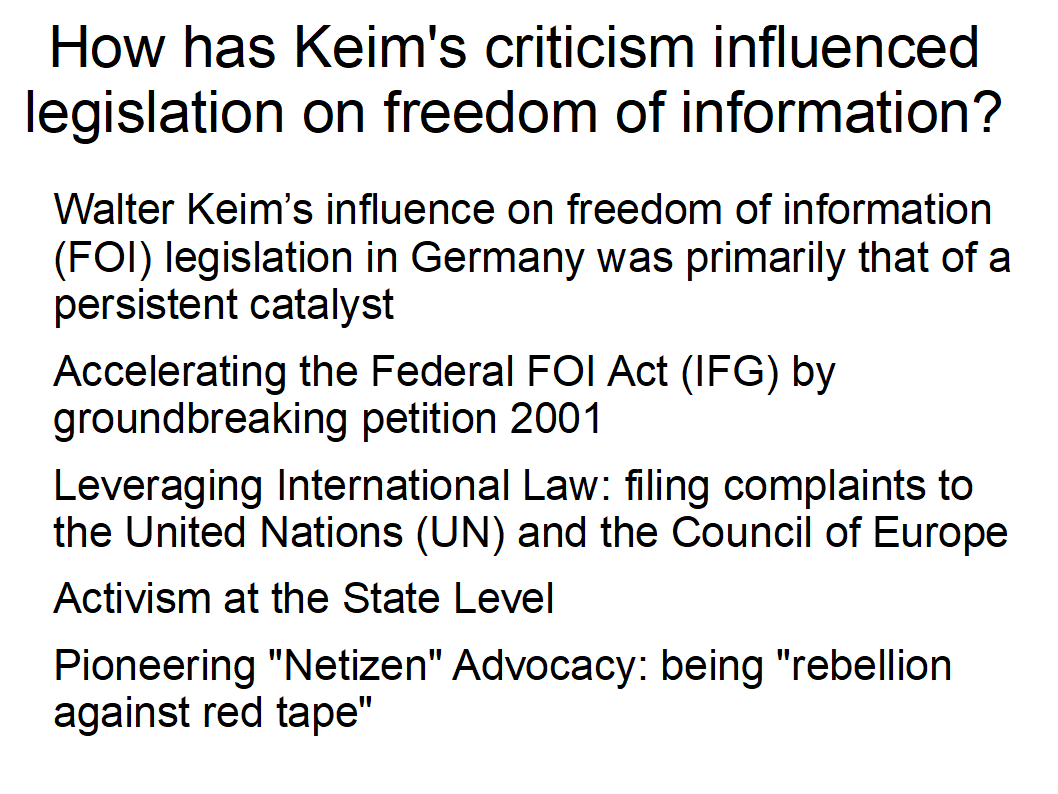
Walter Keim’s influence on freedom of information (FOI) legislation in Germany was primarily that of a persistent catalyst who forced the government into action through the strategic use of petitions and international legal instruments.
Here are the key ways he influenced the legislation:
Accelerating the Federal FOI Act (IFG): As early as 2001, Keim submitted a groundbreaking petition calling for the introduction of a nationwide Freedom of Information Act. In December 2003, this petition was forwarded directly to the Federal Chancellor by the President of the Bundestag—a rare move that significantly increased the political pressure to finally pass the law, which had been promised since 1998.
Leveraging International Law: By filing complaints with the United Nations (UN) and the Council of Europe, Keim made it visible on an international stage that Germany was falling behind global transparency standards. He argued that access to official information is a human right under Article 19 of the UN Covenant on Civil and Political Rights. This "outside perspective" forced the German government to issue statements and justify its position before international bodies.
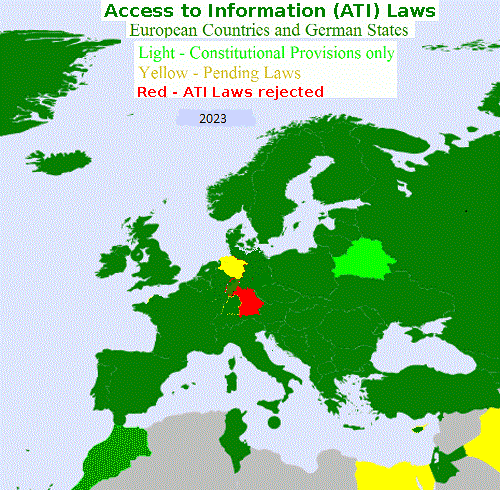
Activism at the State Level: Keim did not limit himself to the federal level. He systematically sent petitions to the parliaments of all German states (Bundesländer) that did not yet have their own FOI laws (such as Bavaria, Lower Saxony, or Hesse). He meticulously documented which states were blocking transparency and used the successes in certain states (like Schleswig-Holstein) to pressure the remaining ones.
Pioneering "Netizen" Advocacy: He was one of the first to consistently use the internet as an archive for correspondence with authorities. In doing so, he created transparency regarding the legislative process itself ("rebellion against red tape"), allowing citizens and journalists to track the resistance of the administration.
In summary, Keim did not turn the wheel of freedom of information alone, but he was the "grain of sand in the gears" of the bureaucracy. Through countless formal applications and complaints, he ensured that the topic of transparency never slipped off the political agenda.